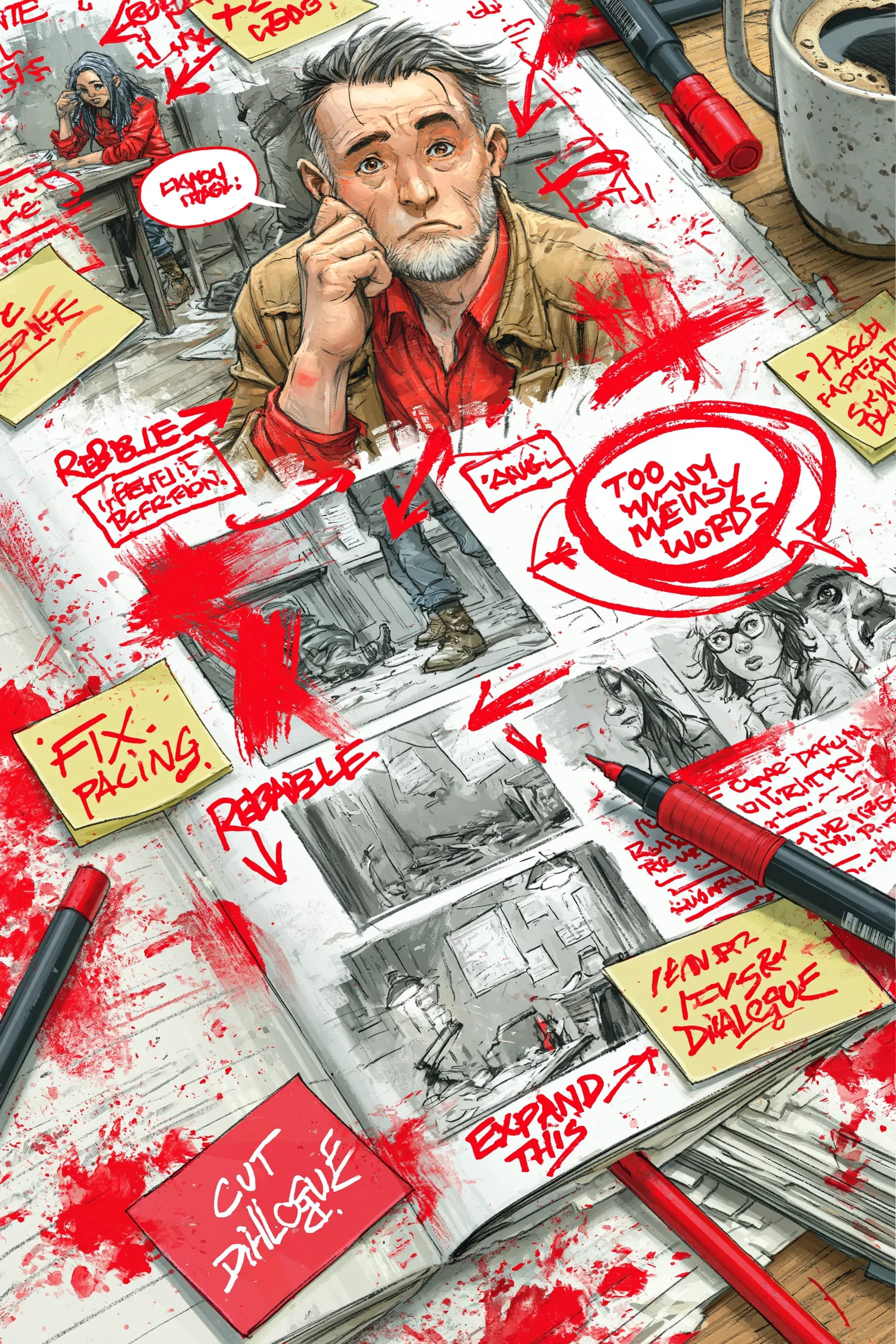
Every experienced comic creator made the same mistakes on their first book. The difference is they learned to spot them. You can skip the painful version and learn them here instead.
Here are the pitfalls that trip up almost every first-timer — and the concrete fix for each one.
Mistake 1: Overstuffing the Panel
Beginners try to cram three actions, four characters, and a full landscape into one frame. The result is a panel the eye cannot parse.
The fix: one clear idea per panel. If a panel has two important moments, it is two panels. Give each beat its own frame and the page suddenly breathes.
Mistake 2: Too Much Dialogue
A page where speech bubbles cover half the art is a page that forgot it is a comic. Readers came for pictures plus words, not a screenplay with illustrations.
The fix: if the art already shows it, cut the line. Aim for roughly 25 words or fewer per panel. Trust your images. Our guide to writing dialogue for comics goes deeper, but the short version is: less, and sharper.
Mistake 3: Characters Who Drift
Page 1, your hero has a square jaw and a green scarf. Page 12, the jaw is rounder and the scarf is blue. Readers notice, and it quietly breaks their trust.
The fix: lock your characters before you draw page one. Hand-drawn artists use model sheets. With NarrInk, the Character Bible holds appearance, wardrobe, and expressions steady across every single panel, so drift simply does not happen. Solid character design up front makes this even easier.
Mistake 4: Weak Pacing
A flat comic gives every moment the same weight — the quiet breakfast and the climactic fight get equal space. The reader's pulse never changes.
The fix: vary your panel rhythm. Many small panels speed time up; one large panel slows it down for impact. Decide which moments deserve room. Our pacing guide breaks this down panel by panel.
Mistake 5: Ignoring the Page Turn
In print and most digital readers, two pages sit together as a spread, and the reader cannot see what is next until they turn. New creators forget this entirely.
The fix: treat the bottom-right panel as a hook. End each spread on a question, a threat, or a surprise so the reader wants to turn. Reveals belong on the top-left of the next page, never spoiled early.
Mistake 6: Skipping Thumbnails
Jumping straight to finished pages feels productive. It is actually the slowest possible route, because every layout problem gets discovered after hours of polish.
The fix: thumbnail first. Rough, tiny sketches let you fix pacing and composition in minutes instead of redoing finished art. We cover the full process in how to storyboard a graphic novel.
Mistake 7: Scope Creep
The most common reason a first comic never gets finished is that it grew. A 20-page story became a 300-page epic with a cast of forty, and the creator burned out before page 30.
The fix: make your first project small on purpose. A tight 8 to 24 page story you actually finish teaches you more than an epic you abandon. Adapting a short story is a great low-scope starting point.
Mistake 8: No Editorial Eye
Beginners are too close to their own story. They cannot tell which scene drags or which reveal lands too early, because they already know the ending.
The fix: get distance. Read your script cold after a few days, hand it to a friend, or use a tool with editorial judgment. NarrInk's narrative intelligence reads your whole story and makes pacing decisions the way a professional comic editor would — see what comic editors actually do.
The Real Lesson
None of these mistakes mean you lack talent. They mean you are new, and new is temporary. Spot them early, apply the fixes, and your first comic will look like the work of someone on their third. For the next steps, dig into panel layout basics or browse the FAQ for practical answers.