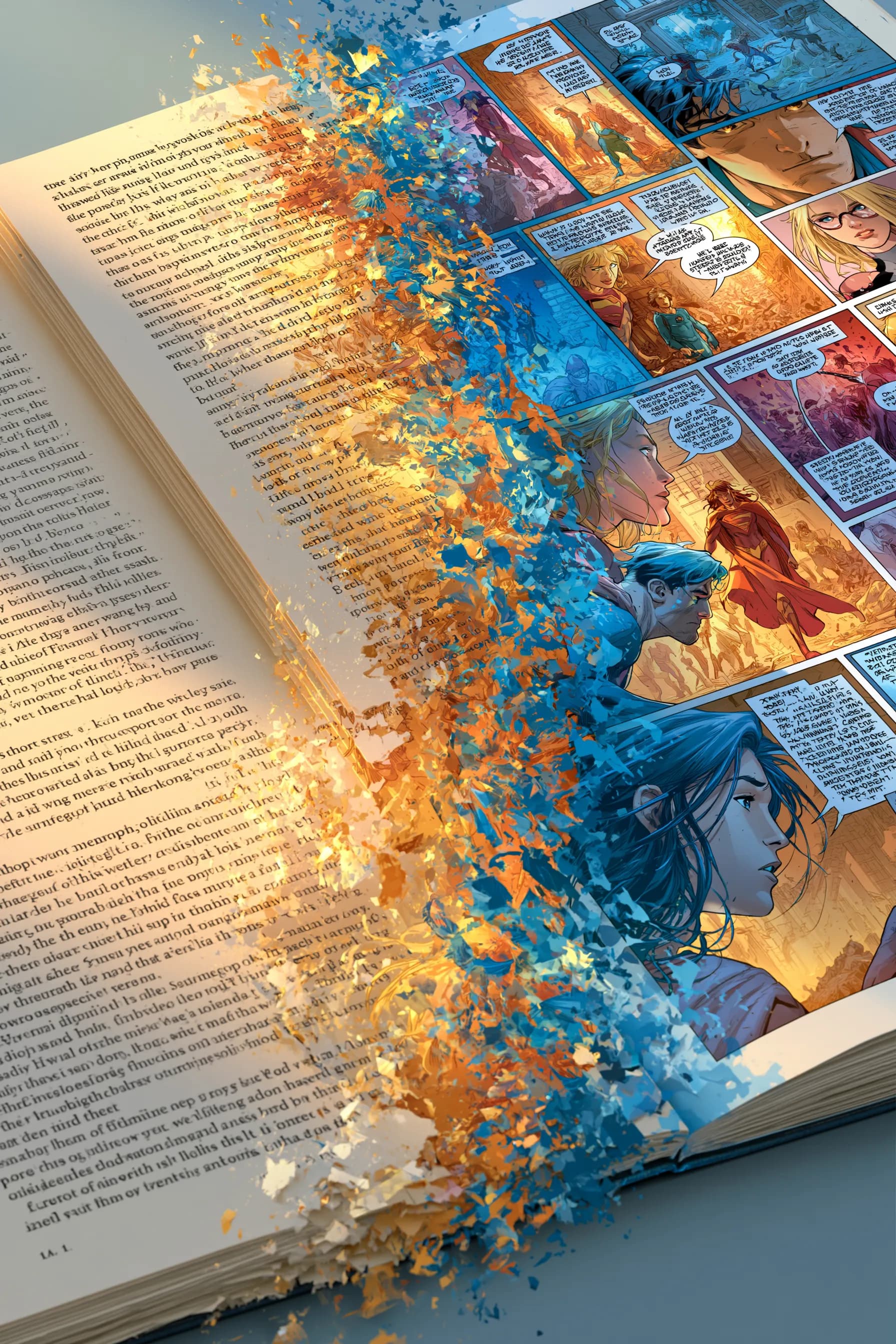
A short story is the perfect size for a comic. It's contained, it has a clear shape, and unlike a novel you can adapt the whole thing without cutting it to ribbons. If you have a 2,000 to 7,000 word story sitting in a drawer, it's a comic waiting to happen.
But adaptation isn't transcription. Prose and comics tell stories in completely different ways. Here's how to move a short story into panels without losing what made it good.
Prose and Comics Are Different Machines
A short story can spend a paragraph inside a character's head. A comic can't — it shows faces, postures, and actions instead. A short story can summarize three days in a sentence. A comic either skips that time in a gutter or draws it.
So the first job of adaptation is translation: every interior thought has to become something visible, or get cut. Hold onto that as you work through the rest of these steps.
Step 1: Find Your Single Strongest Moment
Before you cut anything, find the one image that is the story. Every short story has a peak — a confrontation, a reveal, a final gesture. That moment is your anchor.
Why start there? Because it tells you what everything else is for. Scenes that build toward your peak earn their pages. Scenes that don't are candidates for the cut. The strongest moment also tells you what your cover should be — see creating a comic book cover that sells.
Step 2: Decide What to Cut
This is the hard part, and short stories actually make it easier — they're already lean. Still, prose carries things a comic doesn't need.
Cut first:
- Interior monologue the art can show on a face instead.
- Descriptive passages — the reader will see the room; you don't need to narrate it.
- Dialogue tags and filler — "she said angrily" becomes an angry drawn face.
- Minor scene-setting — a transition the reader can infer from a gutter.
Protect: the strongest moment, every beat that builds to it, and the dialogue that carries voice. When in doubt, keep the visual and cut the verbal.
Step 3: Expand and Compress on Purpose
Adaptation isn't only cutting. Sometimes you expand. A single line — "the fight lasted minutes that felt like hours" — might become a full action sequence across several pages, because action is what comics do best.
And sometimes you compress hard. Three paragraphs of a character walking and thinking might collapse into one wide, quiet panel. The skill is knowing which is which:
- Expand action, confrontation, and visual spectacle — comics shine here.
- Compress transitions, exposition, and quiet reflection.
- Expand the emotional peak — give your strongest moment real room.
This is the same rebalancing skill as the longer-form work in turning a novel into a comic book, just at a friendlier scale.
Step 4: Do the Page Count Math
Roughly, a comic page absorbs 100 to 200 words of source prose, depending on how dialogue-heavy and action-heavy the story is. So a 4,000-word story lands somewhere around 20 to 40 pages.
That's a planning estimate, not a rule — your strongest moment might eat five pages on its own while a transition disappears into one panel. Sketch a quick page-by-page outline and the real count emerges. A loose storyboard is the fastest way to pressure-test it.
Keep the Pacing Intact
The biggest risk in adaptation is pacing drift — you compress the buildup, then your big moment lands with no runway. The whole story has to be balanced against itself.
This is where NarrInk helps. Its narrative intelligence reads your entire short story before generating anything, so it can see the peak coming and pace the lead-up to land it — making the editorial calls a comic editor would, across the whole adaptation rather than panel by panel.
A short story is the ideal first adaptation — small enough to finish, complete enough to feel real. Pair this with a tight pacing plan, a clear comic script, and the long-form approach in how to turn a novel into a comic book.