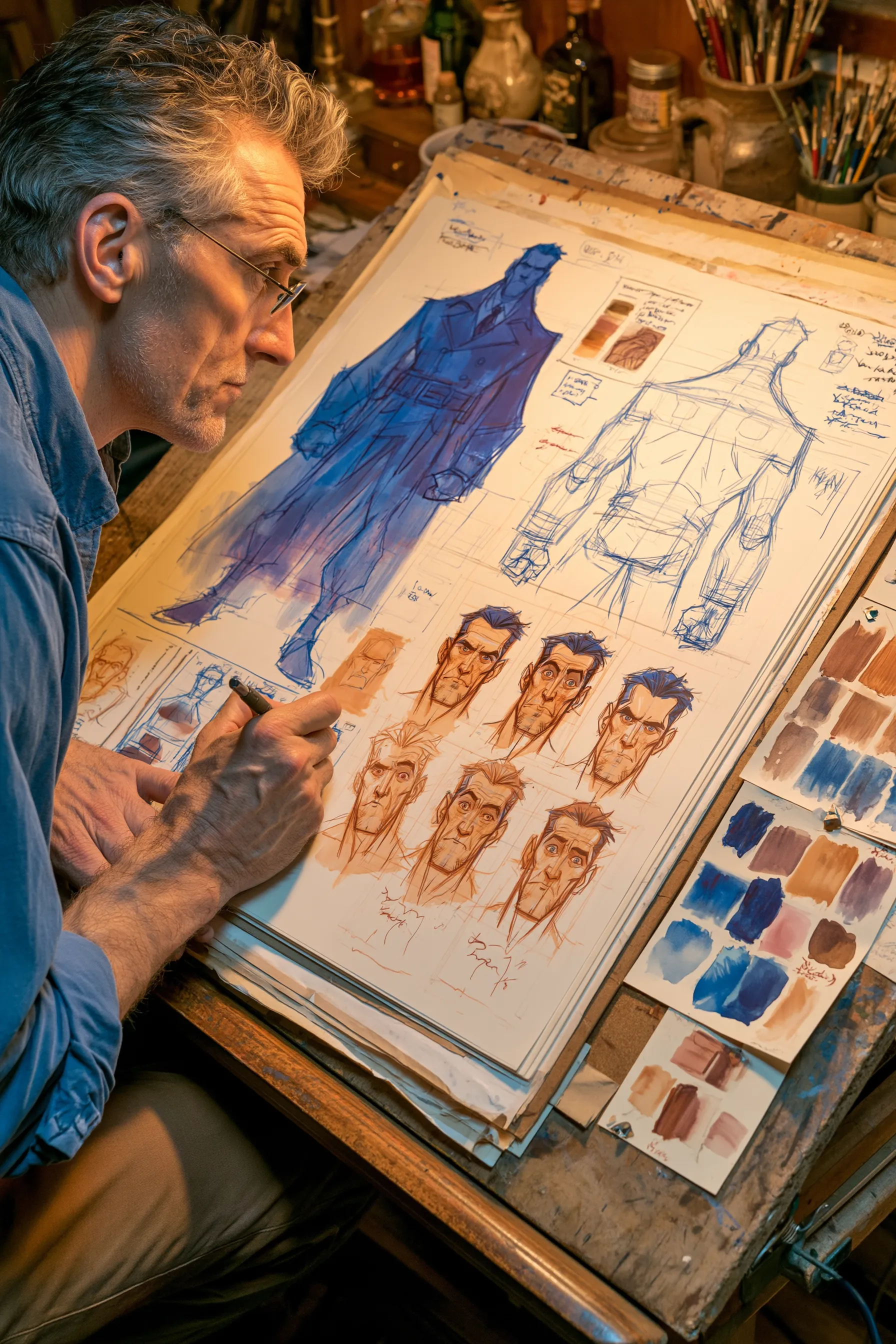
Here's a test. Black out your character so only the outline shows. Can you still tell who it is? If yes, the design works. If no, it doesn't matter how detailed the face is — readers will lose the character on a busy page.
Character design for comics isn't about drawing skill. It's about making people who are recognizable, distinct from each other, and consistent across hundreds of panels. Here's how to get all three.
Silhouette Comes First
The silhouette is the single most important design tool you have. A reader identifies a character by overall shape long before they register the face.
Build a cast that's distinct in outline:
- Vary height and build — don't make everyone the same medium frame.
- Vary posture — a slouch, a stiff stance, a forward lean each read instantly.
- Give one or two characters a signature shape — a big coat, wild hair, a hat.
Do the blackout test on your whole cast standing in a row. If two silhouettes are twins, change one.
Shape Language: Personality in Geometry
Shapes carry meaning, and readers feel it without naming it. Rounded shapes read as friendly, soft, harmless. Sharp angular shapes read as dangerous, sharp, aggressive. Squares and rectangles read as solid, stubborn, dependable.
You don't have to be heavy-handed. A gentle mentor with a round build and soft features, a villain built from hard angles — the reader absorbs the personality before a word is spoken. Lean on this; it does quiet work on every page.
Give Everyone a Distinct Palette
Color is the second-fastest way readers tell characters apart. Assign each main character a small, recognizable palette and stick to it.
- Pick two or three core colors per character and repeat them.
- Make sure your leads don't share the same dominant color.
- Check the palette in grayscale — if two characters go muddy and identical, adjust the values.
A consistent palette also makes a character readable in a tiny background panel. For the full picture on color, see our guide to coloring your comic.
Build a Face That Can Act
Comics live on emotion, and emotion lives in the face. A design with a tiny mouth and flat eyes can't carry a dramatic scene.
Design for range. Give the face features with enough room to stretch — eyebrows that can climb, a mouth that can fully grin or snarl. Sketch your character feeling four things — joy, rage, fear, grief — before you call the design finished. If any of those four look the same, the face needs work.
Make a Model Sheet
A model sheet is the reference document that keeps a character consistent. At minimum it shows the character from the front, side, and back, plus a row of expressions and any key outfits.
This is the difference between a character who feels solid and one who quietly mutates — hair length drifting, jacket changing color, age sliding around. Readers notice that drift even when they can't articulate it, and it breaks immersion. A series with a recurring cast needs this nailed down; our comic series bible guide shows where the model sheet fits into the bigger reference doc.
Staying On-Model Across the Whole Book
Consistency is the hardest part of comics, full stop. Drawing a character once is easy. Drawing them the same way in panel 247 is the real job — and it's where hand-drawn workflows burn the most hours.
This is exactly the problem NarrInk's Character Bible solves. You define a character once — appearance, wardrobe, expressions — and that look is locked across every panel of the comic. No drift, no model-sheet babysitting, no panel 247 problem. The character you designed on page one is the character you get on page one hundred.
Solid character design pays off everywhere downstream. Once your cast is locked, move on to writing your comic script, plan your panel layouts, and pick a look in our guide to the best AI art styles for comics.