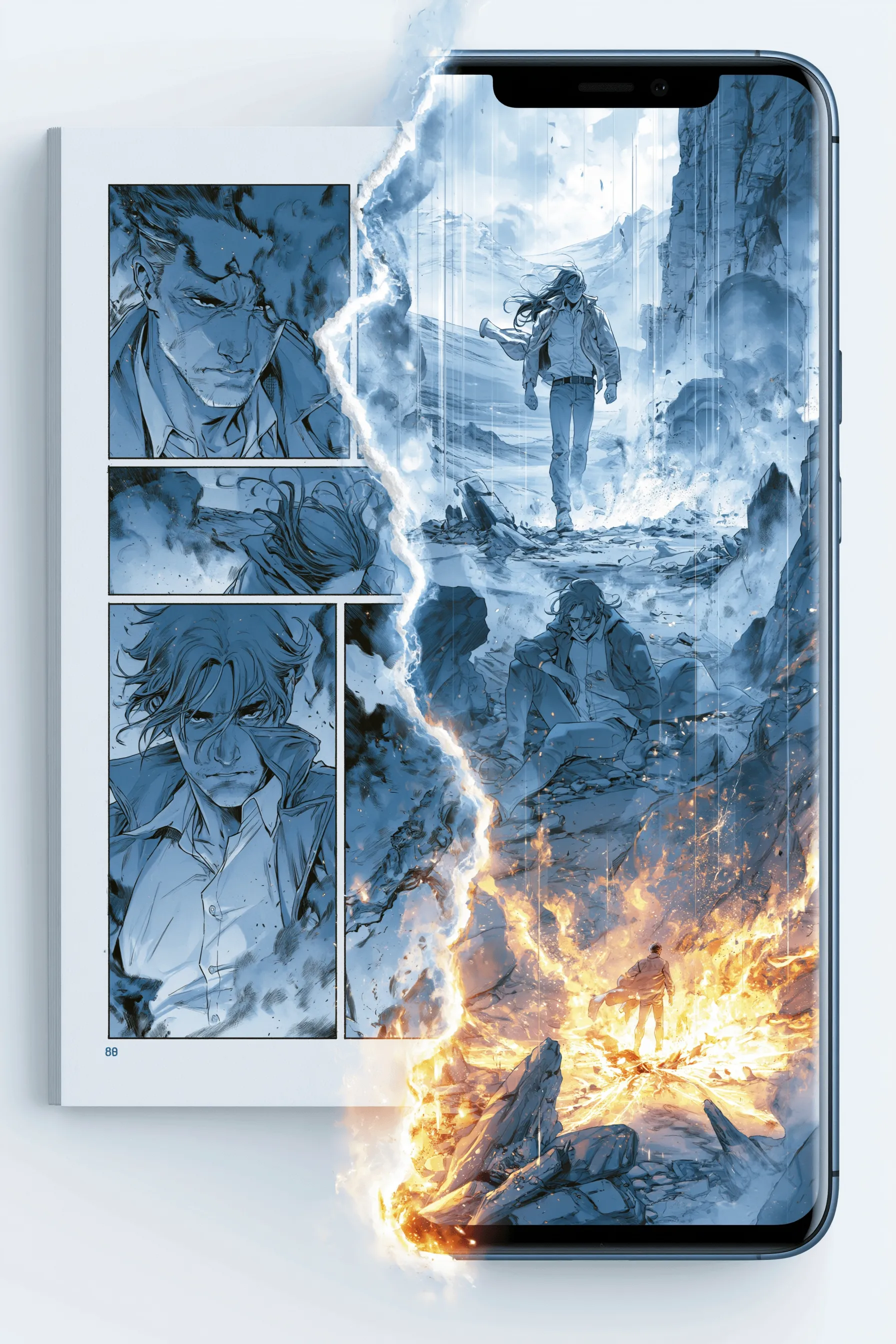
Before you draw a single panel, one decision shapes everything that follows: where will people read this comic? On a phone, scrolling down a feed? Or holding a printed page in their hands?
Webcomic and print are not just delivery methods. They are different reading experiences, and your story should be built for the one you choose. Here is how the formats actually differ.
The Three Main Formats
Most comics today land in one of three shapes:
- Vertical-scroll webtoon — read top to bottom on a phone, one continuous strip. Panels stack; there are no traditional pages.
- Traditional page, read digitally — classic multi-panel pages, viewed on a screen as PDFs or in a reader app.
- Print — the physical book or floppy, with everything a printed object demands.
The split that matters most is vertical-scroll versus page-based, because it changes how you build every panel.
How Format Changes Layout
On a traditional page, the whole page is a unit. Readers take in the layout at a glance, and you can play with panel size and shape across a two-page spread. The panel layout guides the eye in a Z pattern.
Vertical scroll throws that out. There is no page, no spread, only a single column moving down. You guide the reader with vertical rhythm — tall panels, gaps of empty space, the timing of when the next image enters the screen. It is closer to a slideshow than a page.
How Format Changes Pacing
The page turn is print's signature pacing tool. A cliffhanger on a right-hand page, a reveal when the reader flips — that mechanism does not exist in vertical scroll.
Webtoons pace with scroll instead. A long stretch of empty space builds dread before a reveal. A burst of small panels speeds a fight. You control time with the distance a thumb has to travel, not with the flip of a page.
Reader Expectations
Webtoon readers expect short, frequent episodes — often weekly, often free, read in a few minutes on a commute. Print readers expect a longer, denser experience and are willing to pay for a finished object.
Match your story to the appetite. A serialized, cliffhanger-driven adventure thrives as a webtoon. A dense, layered graphic novel you want readers to sit with rewards print.
Distribution and Discoverability
This is where webcomics have a real edge. Posting on a webtoon platform or social channels means a built-in audience can find you for free. Discovery is hard, but the door is open.
Print is the opposite. You control the object completely, but you have to build distribution yourself — conventions, local shops, online stores, or crowdfunding. If print is your goal, our guide to self-publishing in 2026 walks through the logistics.
Monetization
The money works differently in each format:
- Webcomics — usually free to read, monetized through ad revenue, platform programs, memberships on a support platform, or merchandise. Low per-reader revenue, but huge potential reach.
- Print — high per-unit revenue. A reader who buys a book pays real money for it, and a successful Kickstarter campaign can fund a whole run upfront.
Many creators run both: a free webcomic builds the audience, and print collections monetize it.
You Do Not Have to Choose Forever
The good news: a strong story can move between formats. Plenty of print graphic novels began as webcomics, recut for the page.
With NarrInk, the story and your Character Bible stay constant while you generate for either format — so testing a chapter as a webtoon and later assembling a print edition is not two separate projects. It is one story, delivered two ways.
Making the Call
Ask three questions. Where does your target reader already spend time? Does your story lean on cliffhangers or on slow immersion? Do you want reach or revenue first? Your answers point to a format.
Pick the home that fits your story, then build for it from page one. Sharpen your script and plan your marketing around that choice, and your comic will meet readers exactly where they are.