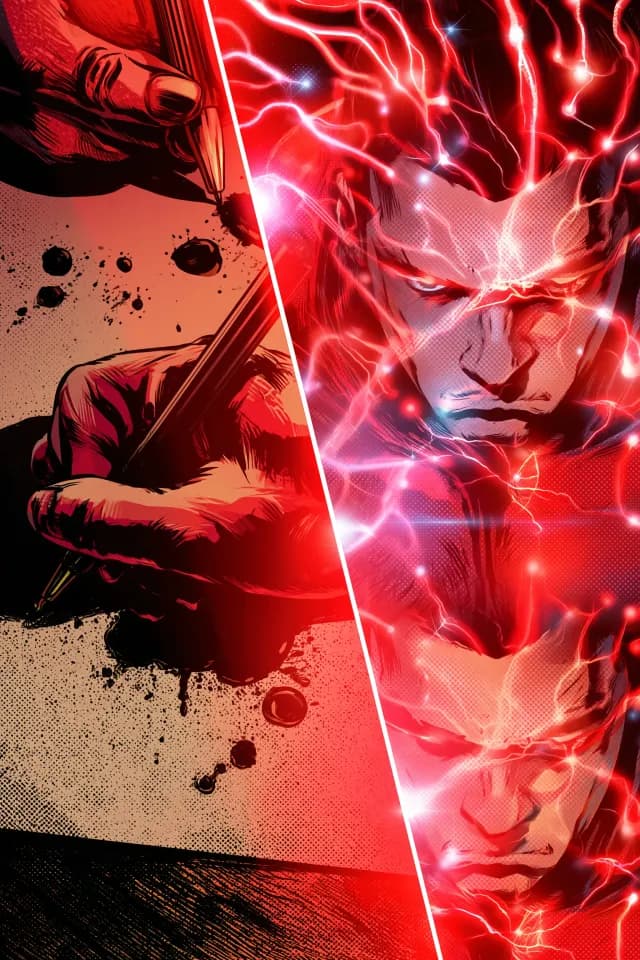
The debate is over. In 2026, AI comic book generators don't replace artists — they unlock a completely different creative pipeline. But what do you actually get when you choose AI over a pencil and ink?
We put generative AI comic book tools head-to-head with traditional hand-drawn workflows across five dimensions that matter most to creators: consistency, pacing, style control, speed, and cost.
1. Character Consistency
Hand-drawn: A skilled artist maintains consistency through model sheets and years of practice. It's labor-intensive but precise — every freckle, every fold in a costume stays exactly where it should.
AI comic book generator: Early AI tools were notorious for characters who looked like different people from panel to panel. That's changed. Modern tools like NarrInk use a Character Bible that locks in appearance, wardrobe, and even emotional expressions. The AI references this bible for every panel it generates, producing consistency that rivals professional studios.
Verdict: Hand-drawn still edges ahead for extreme close-ups and subtle expression work. AI wins on speed of consistency — maintaining the same look across 100 pages without fatigue.
2. Pacing and Panel Layout
Hand-drawn: Panel layout is an art form. Professional comic editors spend years learning how to control the reader's eye — when to use a splash page, when to slow down with small panels, when to break the grid for impact.
AI comic book generator: This is where generative AI comic book tools have made the biggest leap. NarrInk's narrative intelligence reads your entire story and makes pacing decisions the way a professional editor would. It identifies dramatic beats, quiet moments, and action sequences, then selects appropriate panel layouts for each. (We break down exactly what professional comic book editors do and how AI replicates it.)
Verdict: Surprising tie. AI pacing has gotten remarkably good for standard storytelling. Hand-drawn still wins for experimental layouts and rule-breaking design.
3. Art Style Control
Hand-drawn: Total control. Every line is intentional. You can mix media, break rules, and develop a style that's unmistakably yours.
AI comic book generator: Style locking lets you choose a visual identity — manga, noir, superhero, watercolor — and maintain it across an entire series. You trade some spontaneity for remarkable consistency. The best AI comic book tools let you create custom style presets that go beyond generic filters. (See our full breakdown of the best AI art styles for comic books.)
Verdict: Hand-drawn wins for originality. AI wins for accessibility — anyone can produce a visually cohesive comic without years of artistic training.
4. Speed
Hand-drawn: A professional artist can produce roughly 1–2 finished pages per day. A full 24-page issue takes 2–4 weeks of focused work, not counting writing, lettering, and coloring.
AI comic book generator: A complete 24-page comic can be generated in minutes. Editing and refinement might take a few hours. The total time from story to finished comic is measured in hours, not weeks.
Verdict: AI wins by orders of magnitude. This isn't even close.
5. Cost
Hand-drawn: Hiring a professional comic artist runs $100–$300+ per page. A single issue can cost $2,400–$7,200. A full graphic novel? You're looking at five figures, easily.
AI comic book generator: Subscription-based tools make comic creation accessible for a fraction of the cost. An entire graphic novel for less than the cost of a single hand-drawn page.
Verdict: AI democratizes comic creation. Stories that would never be told due to budget constraints can now exist.
The Bottom Line
AI comic book generators and hand-drawn comics aren't competing — they're serving different needs. If you're a storyteller with a manuscript and a dream, an AI comic book generator gets your story into panels now. If you're an artist who lives for the craft of sequential art, nothing replaces the human hand.
The real magic? Using both. Write your story, generate an AI comic book as a visual draft, then hand-finish the panels that matter most. That's the 2026 workflow. Already have a manuscript? Here's how to turn a novel into a comic book step by step.